Renewable natural gas (RNG) is becoming a more readily available and environmentally friendly alternative to traditional fossil fuels. Unlike conventional natural gas, renewable natural gas is derived from organic waste sources, including agricultural residues, wastewater, and landfill gasses. This renewable energy source has gained traction due to its potential to reduce greenhouse gas emissions and promote sustainability. The production of renewable natural gas not only mitigates the environmental impact of waste materials but also provides a cleaner fuel option for various applications.
Renewable Natural Gas
According to the U.S. Department of Energy Alternative Fuel Data Center, Renewable natural gas (RNG) is a pipeline-quality gas that is fully interchangeable with conventional natural gas and thus can be used in natural gas vehicles. RNG is essentially biogas (the gaseous product of the decomposition of organic matter) that has been processed to purity standards. According to the California Air Resources Board’s Low Carbon Fuel Standard, renewable natural gas is lower carbon than gasoline and diesel and some pathways are lower than zero carbon.
On June 1, 2023, the City of Chesapeake awarded Trillium Transportation Fuels, LLC., a four-year contract for the supply of renewable natural gas (RNG) for the City’s fleet of compressed natural gas (CNG) powered solid-waste trucks. The City is presently using over 21,000 diesel gallon equivalents (DGE) of CNG per month in the solid waste fleet. This will be an enormous lifecycle emissions reduction.
Natural Gas Quick Facts
- Natural gas is an odorless, nontoxic gas comprised of a mixture of hydrocarbons, primarily methane (CH4). This alternative fuel supplies approximately a quarter of the energy used in the United States.
- About one third of natural gas consumed in the United States is for residential and commercial use, while only one-tenth of 1% of natural gas is used for transportation fuel.
- Natural gas can be produced from gas wells or as a result of crude oil production. Because of the gaseous nature of natural gas, it must be stored on-board a vehicle in either a compressed gaseous state (CNG) or a in a liquefied state (LNG).
- Natural gas is considered to be the cleanest burning fossil fuel due to the reduced production of greenhouse gases and smog-producing pollutants.
- WATCH: Natural Gas 101
- To learn more about how natural gas can be used in fleet vehicles, click here
Natural Gas Fuels
There are two different forms of natural gas that can be used as a fuel for vehicles. These two fuel types are:
Liquefied Natural Gas (LNG)
- LNG fuel systems are best suited for medium and heavy duty applications. This fuel is produced by super-cooling purified natural gas to -260°F in order to turn it into a liquid. This liquid must be maintained at a very cold temperature so it is stored in double-walled, vacuum-insulated pressure vessels. LNG vehicles are more suited for long range travel than CNG vehicles.
Compressed Natural Gas (CNG)
- CNG is typically used in light, medium and heavy duty applications. These vehicles have about the same fuel economy as a traditional gasoline vehicle but the range for most dedicated CNG vehicles is less than most gasoline or diesel vehicles. CNG is stored in cylinders with a pressure of 3,000 to 3,600 pounds per square inch.
Natural Gas Stations
Use the Alternative Fuels Data Center’s Station Locator to find public natural gas stations in Virginia.
Locations are subject to change, so we recommend calling the stations to verify location, hours of operation, and access.
Natural gas vehicles can easily be fueled at public stations or on-site refueling can be built. Individual home compressors use a slow-fill system for overnight refueling. A small compressor would usually be located in a home’s garage area and would be connected directly to the natural gas supply in the house. In heavy-duty applications, the cost of a high capacity fast-fill private or public station ranges from $200,000 to as much as $3 million.
The future holds great potential for natural gas because it can potentially be used in fuel cell vehicles to make hydrogen. Researchers have found that fuel cell vehicles using hydrogen produced from natural gas could present an attractive solution for cutting greenhouse gas emissions.
CNG Fast-fill Stations
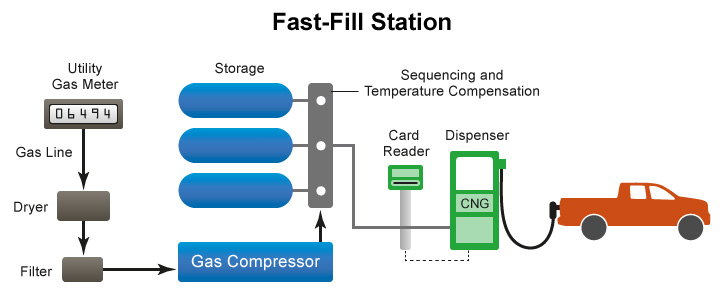
Fast fill stations are used ideally for retail situations where light-duty vehicles can fill up quickly at random intervals. The required infrastructure for this station only takes up as much space as a parking space. Fuel for this station is provided by a local utility line at a low pressure and the compressor on site creates a high pressure gas that can be used in these vehicles. Drivers filling up at a fast fill station experience similar fill times to gasoline fueling stations—less than 5 minutes for a 20 gallon equivalent tank. Drivers use a dispenser to transfer CNG into the tank. The dispenser uses sensors to calculate pressure and measure the number of GGEs delivered to the tank, taking temperature into account.
CNG Time-fill Stations

Time fill stations are used mainly for fleets and work well for vehicles with larger tanks that refuel at a central location every night. Unlike fast-fill stations, vehicles at time-fill stations are generally filled directly from the compressor, not from fuel stored in tanks. The size of the compressor needed depends on the size of the fleet. Although there is a small buffer storage tank, its purpose is not to fill vehicles, but to keep the compressor from turning off and on unnecessarily—wasting electricity and causing undue wear and tear on the compressor. The storage tanks are sometimes used to “top off” vehicle tanks during the day. Fuel times depend on the number of vehicles, compressor size and the amount of buffer storage. This process can take minutes to hours depending on these factors and the need of the consumers.
Use this interactive animation to learn more about how the outside temperature and fill speeds affect the final fill volume in compressed natural gas vehicle tanks. Learn more about filling CNG vehicle tanks.
The Benefits of Using Natural Gas
-
- The use of natural gas reduces petroleum consumption: Compressed natural gas vehicles use 90% less petroleum as compared to gasoline engines.
- Natural gas is better for the environment: Natural gas vehicles typically emit 6-11% fewer greenhouse gas emissions than comparable gasoline and diesel vehicles throughout the vehicle’s lifecycle. Significant reductions in carbon monoxide and evaporative volatile organic compound emissions are seen in comparison to the emissions of a traditional gasoline vehicle.
- Natural gas is domestically produced: Most of the natural gas consumed in the United States is produced internally. This allows for increased energy security as well as the creation of jobs
- Natural gas is less expensive than traditional gasoline. In order to see the difference in fuel costs, try using the cost calculator below.
What Vehicles Can Use Natural Gas and How Do They Perform?
There are three types of natural gas vehicles:
- Dedicated: These vehicles run only on natural gas.
- Bi-Fuel: These vehicles run on either natural gas or gasoline through the use of two separate fueling systems.
- Dual-Fuel: These vehicles have fuel systems that run on natural gas but use diesel fuel for ignition assistance. These vehicles are typically only available for heavy duty application.
One of the major benefits of using natural gas vehicles is that users experience no differences in horsepower, acceleration, or cruise speed in comparison to a traditional gasoline powered vehicle.
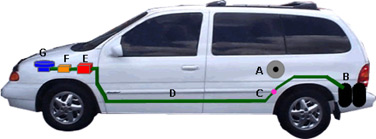
The image shows how natural gas vehicles that use CNG work. First, CNG enters the car through the natural gas fill valve (A). The gas entered high-pressure cylinders (B) and as natural gas is needed to power the vehicle, it travels through the master manual shut-off valve (C). This valve connects to the high-pressure fuel line (D) and enters the engine compartment. The pressure of the gas is then decreased as it enters the regulator (E) and passes through the solenoid valve (F). The solenoid valve shuts off when the engine is no longer running. Finally, the gas flows through the carburetor or fuel-injection system (G) and enters combustion chambers where it can be burned to produce power, like regular gasoline.
State and Federal Laws and Incentives
To learn more about available incentives and laws relating to the use of natural gas vehicles, click here.
Clean Cities Natural Gas Working Group
Virginia Clean Cities conducts bi-monthly working group webinar calls with interested fleets, fuel providers, and other groups from around Virginia to discuss natural gas. If you are interested in joining the CNG Working Group, please contact us! Below is the presentation from the last working group call:
Hank Brown, TFC Recycling (PowerPoint by Stephe Yborra, NGVAmerica)
Past Presentations
Steve Bernstein, Jones and Frank
Alleyn Harned, Virginia Clean Cities
Larry Bowling, MAERSK Line, Limited
Natural Gas Toolkit
Virginia Clean Cities worked with the East Tennessee Clean Cities Coalition to create the Natural Gas Toolkit http://www.ngtoolkit.net. This toolkit allows you to find and utilize two primary numbers, the fuel price difference and your vehicle cost difference, to calculate a simple payback period. Perhaps more importantly, it helps you get basic pieces of information in one place to prepare for potential funding opportunities in the future. What you need to know is that this is just a starting point for looking at natural gas for your fleet. Clean Cities coalitions, NGVAmerica, and other resources are out there to help you find the other numbers you need, so use the resources page to find those as you need them.